Unreal Engine 5.8 · Plugin · Now on Fab
Box3D Deterministic Physics
Rigid-body simulation that runs on its own fixed 60 Hz clock — independently of Chaos, or right alongside it. The same scene, the same inputs, the same result, every run.

What it is
A self-contained physics runtime for Unreal. A world subsystem steps the simulation at a fixed 60 Hz with four substeps, entirely separate from Chaos. Body and shape components drive your existing actors, so you can simulate one system deterministically while Chaos keeps handling the rest of your game.
The engine underneath is Box3D by Erin Catto, the 3D sibling of Box2D — a data-oriented C17 solver built for large piles of bodies, with continuous collision detection, island-based sleep, and cross-platform determinism.
Why Box3D
01
Deterministic by design
Driven by a world subsystem on a fixed 60 Hz, four-substep clock rather than by your frame rate. The same scene, stepped from the same state with the same inputs, produces the same result run after run — verified by an automated test suite.
02
Runs alongside Chaos
Simulate what needs to be deterministic in Box3D and leave the rest of your game on the engine’s physics, or drive individual actors with it. No project physics settings change.
03
Records and replays natively
Simulations write .b3rec files that play back exactly, in-engine. Separately, Take Recorder can capture simulated actors into a Level Sequence for cinematics.
04
A full joint set
Revolute, distance, spherical and weld joints, with break events and live motor setters. Sensors carry begin and end overlap events, and conveyor surfaces drive contacts by surface tangent velocity.
05
Scales to big scenes
Bodies sleep and islands collapse as scenes settle, and an instanced-mesh path handles scenes with thousands of bodies.
06
Blueprint-ready, source included
Bodies, shapes, joints, sensors, queries, contact events and solver settings are all exposed to Blueprint — a Blueprint-only project can use all of it. Full C++ source ships with the plugin.
Twelve demo maps
The plugin ships its demos as playable content, not marketing footage. Every one is engine-content-only, carries a live stats overlay, and exposes its parameters for tuning.

Bridge
A suspension deck built out of revolute joints, then loaded until it sags.

Dominoes
The determinism showcase: run it, record it, replay it, get the same cascade.
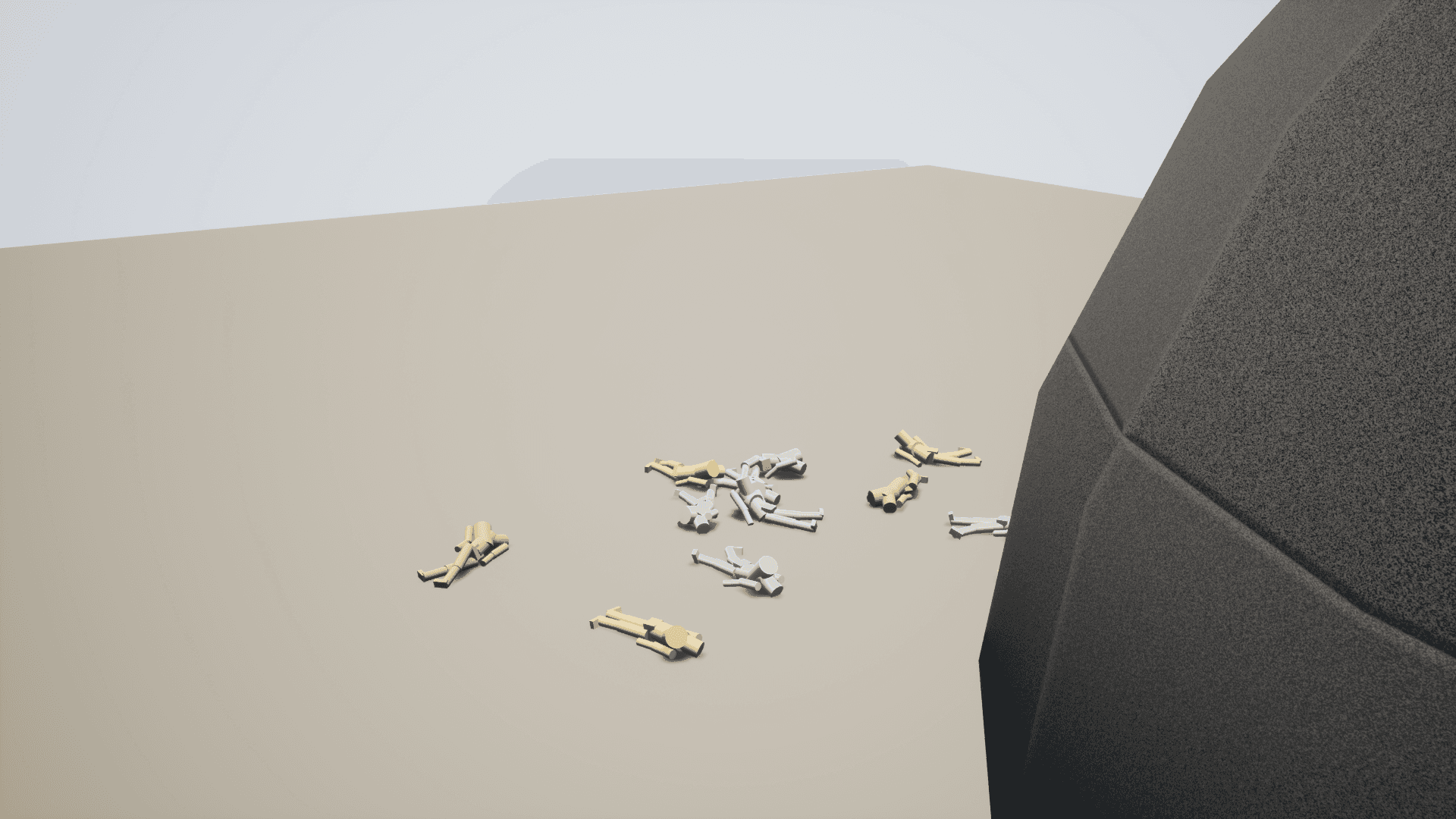
Ragdoll Pile
Articulated bodies thrown into a heap and left to settle.

Conveyor Circuit
Conveyor surfaces moving cargo around a closed loop.

Jenga
Stacking stability — the case where solvers usually show their seams.

Demo Hub
The entry point that links every one of the twelve demo levels.
Built with Box3D
Physics-driven games and experiments running on the plugin — hit reactions and ragdolls, flocking, and destruction.
Fighting game
A fighting game prototype that uses Box3D for its hit effects and ragdoll system.
Fish flock, realtime follow
A flock of Box3D bodies tracking a moving target in realtime.
Water physics destruction
Destruction driven by water forces, simulated with Box3D.
Honest limitations
Triangle-mesh collision is Static-body only. That is a Box3D engine constraint, not a wrapper gap — a moving object needs convex or primitive shapes.
No height-field shapes yet.
No .b3rec to Sequencer import. Take Recorder captures live actor transforms instead.
Chaos and Box3D do not interact. A Box3D body is static as far as Chaos is concerned, and vice versa.
Windows (Win64) only in 1.0.0.
Try it in your own project
Unreal Engine 5.8, Win64, C++ source included. A free compiled sample project is linked from the listing, so you can play the demos before you commit to a licence.